
Path to function: Accounts > List
The Accounts list shows user accounts managed through OpenAthens. If applicable, it also shows accounts that are populated from a local user directory. The list doesn't include accounts under sub-organisations.
Click on an account to view or modify the details of that user.
Options for sorting and selecting users are the same as when running a search. You can download or modify accounts in bulk using the Actions menu, which appears once you select one or more accounts by ticking their checkboxes.
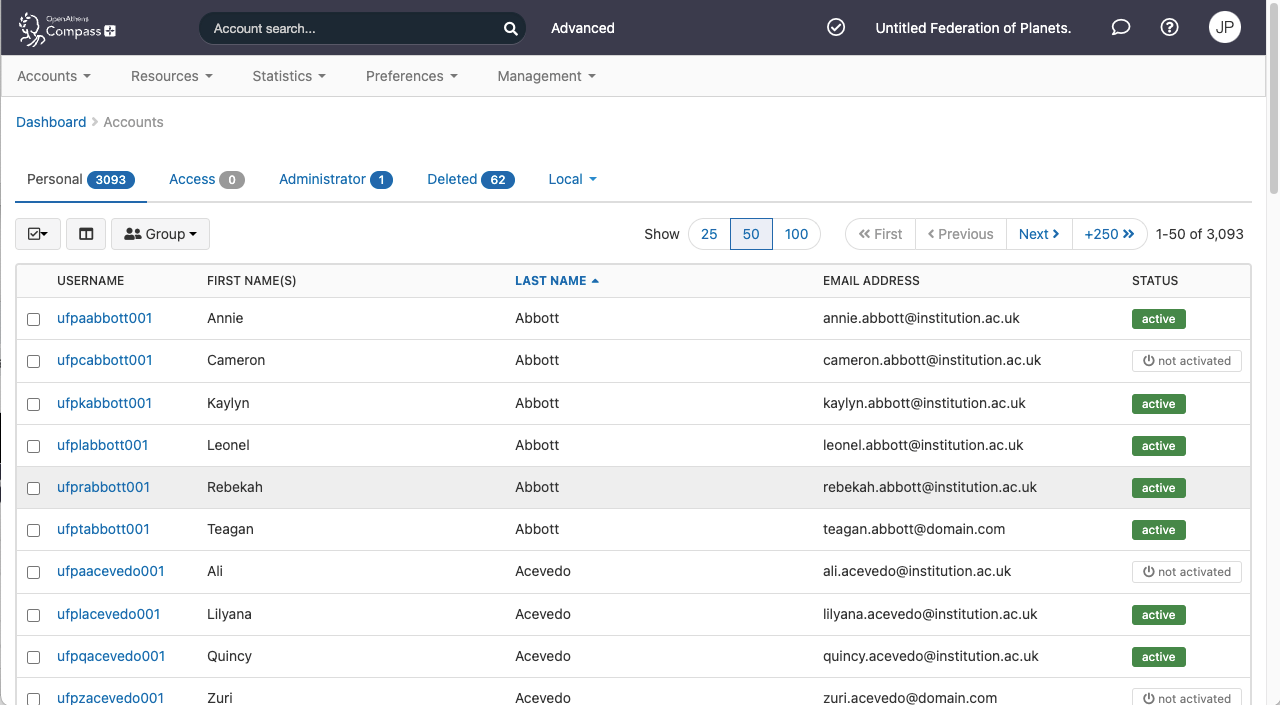
Types of account
Accounts in the list appear under several tabs.
Personal
Personal accounts are individual user accounts managed in OpenAthens. You can create personal accounts individually or through bulk upload.
Access
An access account identifies a location from which people can access your resources without needing individual logins. This location is defined by IP address and might be a building or a specific computer terminal. By using access accounts, you can allow people who aren’t registered in OpenAthens, such as campus visitors or users in a public library, to read subscription content while on your premises. The login details for the account can be posted publicly near a computer. See Create - Access account and How to handle walk-in users.
Administrator
An administrator account is configured similarly to a personal account, but gives admin access to OpenAthens. Administrator accounts are intended for managing your resources, managing users, and performing other administrative tasks. See Create - Administrator account.
Deleted
This tab shows accounts that have been deleted either through the OpenAthens admin interface or through bulk upload. (Local accounts, which can be deleted only from the external user directory, are not shown here.)
Deleted accounts are purged automatically after 30 days. If required, you can recover deleted accounts. You can also permanently delete accounts before the 30-day period ends.
Local
Local accounts are populated through connections to external user directories such as ADFS or LDAP. You cannot create local accounts, delete them, or edit their core details through the admin interface. You can modify some of their data, such as access permissions.
If you have one or two local directory connections, there will be a tab or tabs labelled with their names. If you have more than two, there will be a single tab called Local. By clicking this tab, you can select the connection you want to view from a drop-down list.
Data of individual users is populated once they have signed in. If you see an entry without data, then either the user has not logged in since attributes were mapped for the connection, or the source did not provide that data. All mapped attributes can be selected for display whether or not they contain data.
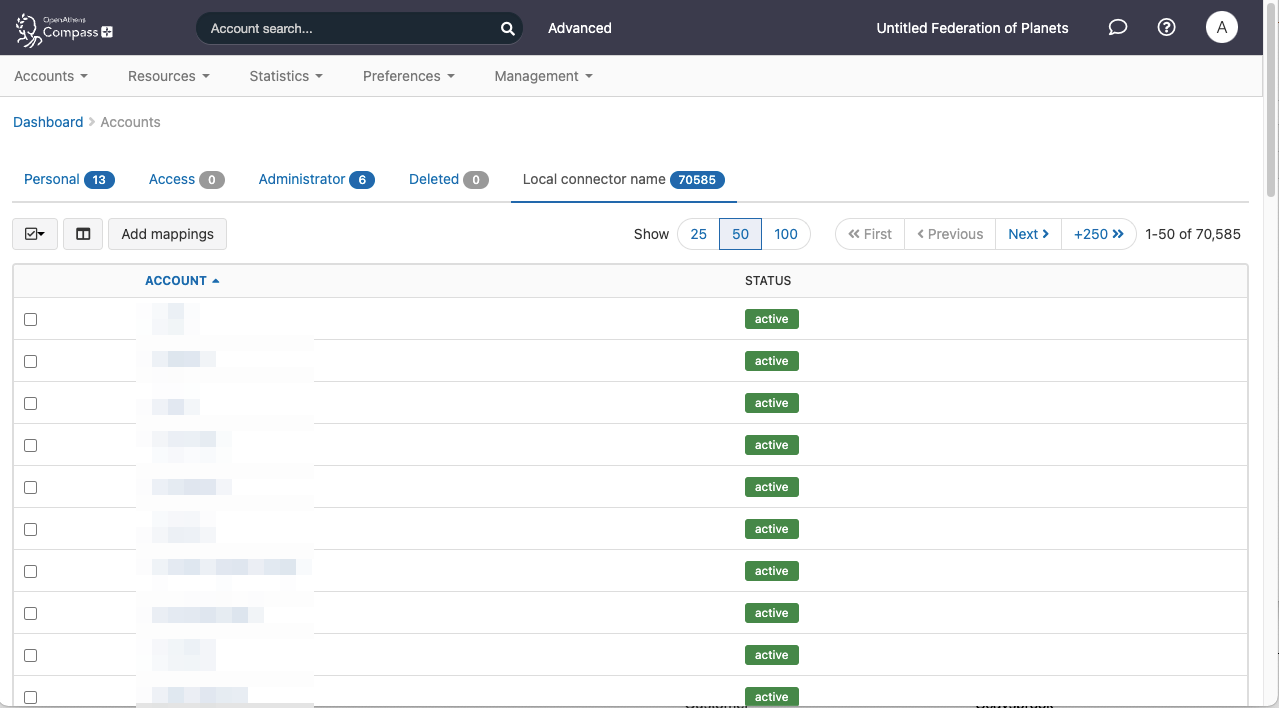
If the mapped data is multi-valued - e.g. the memberOf field - then only one value can be displayed. All the values are cached, however, and can be used in things like permission set rules.
You can clear mapped data by checking the boxes next to accounts and selecting delete from the Actions menu. If and when a cleared user is seen again, their data will reappear. The display always represents the data for a user as of the last time they accessed OpenAthens. Changes in the local directory will be reflected when the user next logs in.
Depending on how you use this data, you might choose to regularly clear all of it, or you might choose to map an attribute such as expiry date from your local systems on to an OpenAthens attribute so you can be more selective. Either way, data will automatically be cleared after 365 days of not being seen. You can set a lower limit on the connection if you need to.
Use the Add mappings button when you want to limit access to only pre-mapped local accounts. At least one user must have logged in for this function to be available.
Account statuses
The following table explains terms that you might see in the Status column in the list of accounts, as well as in other locations such as individual account details, an account’s Activity log, and bulk upload and download of accounts.
|
Status |
For personal or administrator accounts registered in OpenAthens |
For local accounts |
|---|---|---|
|
active |
Account has been activated by setting a password, either by the user themselves or by an administrator |
User has signed in to OpenAthens at least once |
|
banned |
Account is blocked because of possible misuse |
Account is blocked because of possible misuse |
|
disabled |
n/a |
Account has been disabled in OpenAthens (by pressing the Disable button on the account details page) |
|
expired |
Account has passed its scheduled expiry date |
n/a |
|
locked |
Account is blocked following repeated failed login attempts |
n/a |
|
never used |
n/a |
Account ID has been pre-mapped but the user has not yet signed in |
|
not activated |
Account has not been activated by setting a password. (Shown in the list of accounts and on the account details page) |
n/a |
|
pending |
Account has not been activated by setting a password. (Shown in activity logs, bulk upload and download files, and the API) |
n/a |
|
suspended |
n/a |
Account is blocked under a rule set for the local connection |